White-nose Syndrome

About White-nose Syndrome

Little brown bats with white-nose syndrome in New York (N Heaslip, NY Dept. of Environmental Conservation)

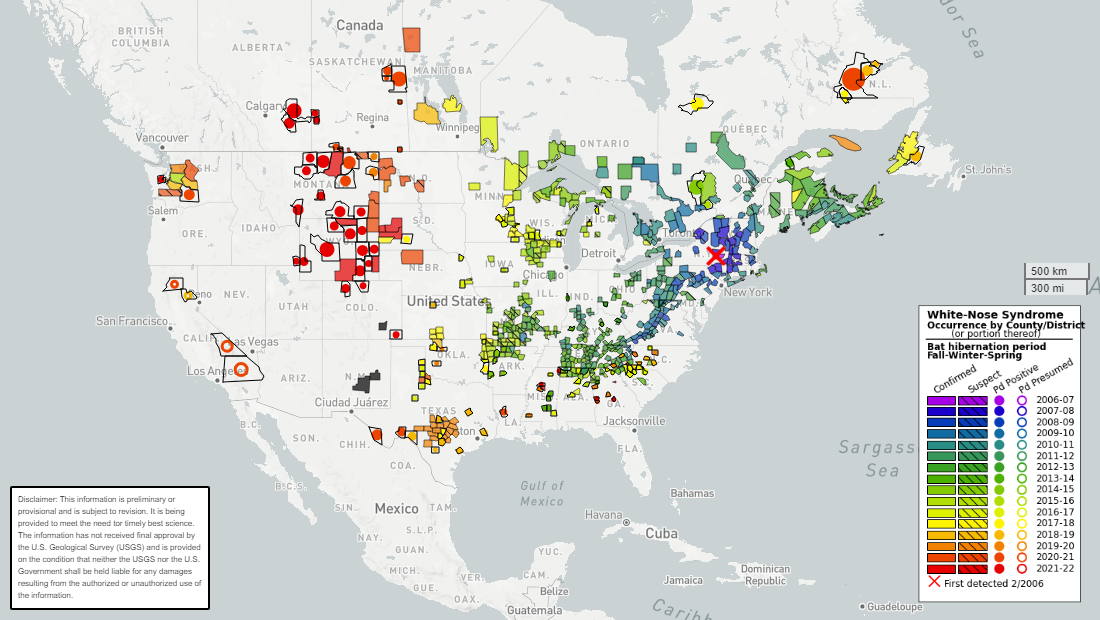
White-nose Syndrome (WNS) has been associated with the deaths of over 1 million bats in nine states across the northeastern United States. In some hibernation sites, numbers have declined by 80-100% since 2006 when the condition was first identified. All six resident bat species have been affected.


WNS Map - USA

Bat Conservation International map of affected areas in the USA

Larger version of USA affected areas map (as above)

Named after the distinctive white-fungal growth found on many of the affected bats, WNS has been named as a new species of soil fungus Geomyces destructans. WNS is still poorly understood; researchers know very little about its spread and transmission and it is unclear whether the fungus itself is killing the bats, or whether the fungus is a secondary infection.  One suggestion is that the fungus bothers the bat and causes energetically-expensive arousals from hibernation, resulting in bats running out of stored energy and starving to death.

The following websites provide further information on the situation in North America:

Guidance for batworkers and cavers

There has been a confirmed diagnosis of the fungus associated with WNS on a bat (Myotis myotis) hibernating near Périgueux in France (Puechmaille et al. Feb 2010, Emerging Infectious Diseases). The affected bat was found hibernating in March 2009. This bat was not underweight, unlike the infected bats in the US, and was released after examination.

Bats with fungal growths on the muzzle have been reported in parts of Europe (including the Netherlands and Germany) since the 1980s, but these have not been associated with mass mortalities. To date there has not been a confirmed diagnosis of WNS or the associated fungus in the UK.

There is an assumption that the fungus was introduced into the US from Europe by human intervention, perhaps by a caver or batworker. As such, Geomyces destructans may be a recent mutant in the US.

Human health implications are not known, but there is no information indicating that people have been affected after visiting sites where WNS has been found.

As a precautionary measure, the Bat Conservation Trust has drawn up WNS guidance for bat workers and cavers in the UK, which provides information on:

  • what to look out for;
  • how to contribute to the national surveillance programme; and
  • how to minimise risk of spread.

White-nose Syndrome guidelines for bat workers and cavers


If you are a licensed bat worker and undertake hibernation surveys as part of the NBMP, or other voluntary activities, keep us up to date with your observations:


Results from the 2008/9 White-nose Syndrome surveillance forms

Thanks to everyone who returned White-nose Syndrome forms following the 08-09 hibernation checks. We received feedback from 42 bat workers covering 114+ sites around the UK.  In SW England, we received two separate reports of dead bats with white fungus over the winter season.  In both cases, bats were submitted for testing and, in both cases, results were negative (the fungus was not geomyces).

White fungus was found on a small number of dead bats in isolated cases elsewhere in the country, but the specimens were too decomposed to test. In expert opinion, these cases were very unlikely to have been associated with WNS.